After their success in the Abbott and Costello movies Buck Privates (1941), In the Navy (1941) and Hold That Ghost (1941), Universal decided to star The Andrew Sisters in their own series of B musicals. Naturally one of these films was a military themed musical comedy in the vein of Buck Privates. Even the title would be similar to that Abbott and Costello classic. The Andrew Sisters would not be the only returning in Private Buckaroo. Shemp Howard (of Three Stooges fame) also returned for this movie. While in Buck Privates, Shemp had a smaller role, in Private Buckaroo Shemp has a much larger role providing much if the comedy in this musical comedy.
Like Buck Privates, the storyline is basically an excuse for music and comedy. The storyline that is here involves an entertainer named Lon Prentice (Dick Foran), who after getting into the army tells his commanding officer (Richard Davies) that he thinks most military training is useless. His commanding officer orders that he does not have to do any of this training, which causes his fellow recruits to turn against him. He soon learns his lesson.
Though this movie is strictly a programmer and will never be confused for one of the best Hollywood musicals it is a lot of fun for what it is. The musical numbers are truly excellent. The Andrew Sisters are at the top of their game here and the songs they perform here are all delightfully. However, the other musical performers here are excellent as well. Dick Foran, Joe E. Lewis and especially legendary jazz trumpeter Harry James provide some great music. There is not a weak song number or weak performer in the whole film. The soundtrack simply provides one great song after another. Shemp is at the top of his game as well. Though the humor can be a bit hit and miss (the scenes with the little girl are not especially funny), Shemp gives it his all. His scenes with Mary Wickes are the comedic highlights of the movie and often made me laugh out loud. The storyline may not be much to write home about but great music, an excellent cast and a few really funny moments make this a delight for fans of B musicals.
Though this was advertised as an Andrew Sisters movie and the sisters receive top credit, the real star of the film was Dick Foran (born June 18, 1910, died August 10, 1979). Dick Foran is best remembered by fans of B Westerns. After the success of Gene Autry's singing cowboy movies, in the mid-1930's Warner Brothers cast Foran as the lead in a series of singing cowboy picture meant to compete with Autry's. When in the 1940's Foran moved to Universal he was often cast in comedies and horror films. Some of the comedies he appeared in were appropriately western themed including the W.C. Feilds and Mae West vehicle My Little Chickadee (1940) and the Abbott and Costello flick Ride 'Em Cowboy (1942). He appeared in two of the Universal monster movies featuring the mummy, The Mummy's Hand (1940) and The Mummy's Tomb (1942). Returning to his B-Western roots, he also starred in two western serials for Universal Winners of the West (1940) and Riders of Death Valley (1941). He would spend the latter part of his career working in television appearing in episodes of such Science Fiction Theatre, Sheriff of Cochise, Father Knows Best, Maverick, Wanted Dead or Alive and the Swamp Fox episodes of Disney's anthology show.
The movie's director was Edward F. Cline (born November 4, 1891, died May 22, 1961) was one of the best comedy directors of his day. He began his film career at Keystone studios in 1914. He briefly worked as a Keystone Cop before being promoted to an assistant director. By 1916 he had become one of the studio's most prolific directors. He would direct nearly sixty comedies for the studio and has been credited with the formation of the Mack Sennet Bathing Beauties. Silent comedy fans might know him best for his work with Buster Keaton, where he was credited as a co-director (along with Keaton) on some of the great comedian's silent shorts as well as the feature film Three Ages (1923). He continued to direct wonderful comedies well into the sound era. Some of his best work is his work with W.C. Feilds. He directed Feilds in such classic movies as Million Dollar Legs (1932), You Can't Cheat an Honest Man (1939), My Little Chickadee, The Bank Dick (1940, also featuring Shemp) and Never Give a Sucker an Even Break (1941). He would also work with his old partner Buster Keaton again during the talkie era. He directed Buster in The Villain Still Pursued Her (1940) and the ill-fated TV shows The Buster Keaton Show and Life with Buster Keaton.
Though Harry James is seen in the army in this film, he was unable to join the military in real life due to a back injury. Also seen here is a teenage Donald O'Connor along with his then screen partner Peggy Ryan. Universal hoped that these two could compete with MGM's Mickey Rooney and Judy Garland.
Film Bulletin, 1942
The movie mostly received poor reviews from critics. Bosley Crowther stated, “For consistent ineptness, for frantic dullness, for the sheer impertinent waste of film at a time when Hollywood is supposedly seeking ways of saving raw stock.” A review in The Film Daily stated, "'Private Buckaroo' is just a lot of song strung into a feature length picture with interludes of slapstick here and there. There is no story to speak of and no originality in the presentation of the material. The action takes place in a night club and an army camp. It's all too exaggerated to merit belief. The film's musical content - mostly of the popular sort - should give the production a break with young folks. Older people will find little in 'Private Buckaroo to appeal to them."
Motion Picture Daily, 1942
-Michael J. Ruhland
Resources Used
A-Z of Silent Film Comedy by Glenn Mitchell
Chase! A Tribute to the Keystone Cops edited by Lon and Debra Davis.
Studio: MGM. Runtime: 20 minutes. Production Number 685. Release Date: July 6, 1933. Director: Jack Cummings. Script: Ted Healy, Moe Howard, Matty Brooks. Cast: Ted Healy, Moe Howard, Larry Fine, Curly Howard (Themselves), Bonnie Bonnell (Fairy Princess), Ethelind Terry (Woman in the shoe), The Rounders (Woman in the Shoe quintet), The Dodge Twins (Turn of a Fan dancers), Lottice Howell (Turn of a Fan singer). Music and Lyrics: Nacio Herb Brown, Herbert Stothart, Arthur Freed, Clifford Grey. Chorographer: Sammy Lee. Working Title: Nursery Rhymes.
By the time Ted Healy and His Stooges made their return to the screen, it had been nearly three years since their first movie. In between these films, the team had been performing on stage. One major change though had occurred over this period though. Shemp had left the act and his young brother Jerry Howard (soon to be renamed Curly) had taken his place. At first Curly had long, wavy-brown hair and a mustache. Legend has it that Curly shaved his head and his mustache right after joining the team but photos of the team during this time had shown Curly with long hair and mustache. The salary structure of the team would also change with Curly getting $75 a week, Moe getting $140 and Larry getting $125. Moe would later remember that Ted was a first nervous about this change because Curly had limited stage experience. Moe would later state, "What Curly did for the first three weeks was just run across the stage in a bathing suit, carrying a little pail of water. That's all he did, run back and forth, until we gradually worked him into the act." Curly's trademark high-pitched voice came from jitters during his first stage appearance, but audiences loved it, and it soon became an accepted part of the act.
It was at a performance at the Club New Yorker in 1933 (they performed there from March 2nd to April 5th, 1933), when an MGM scout caught the team and signed them to a studio contract. This contract would have Ted Healy and His Stooges star in a series of musical comedy shorts as well as having supporting roles in feature films. From this moment on, the Stooges would rarely be off movie screens for the rest of their careers.
In this short film, the Stooges play Ted Healy's children. Ted is trying to get the boys to sleep but nothing seems to be working. Because of this Ted turns to a Fairy Princess (Bonnie Bonnell) for help. The Fairy Princess then puts on a musical revue show for the boys.
This is a charming little film. Though the Stooges aren't given a whole lot to do here, they are delightful. It is easy to see why they would soon become big movie stars. Most of their jokes here aren't up to par with those in their later shorts but the trio handles them well. In true Stooge fashion they make even the weakest gags kind of work. This is not to say every gag is weak though as the ending gag made me laugh out loud. This short is also a visually handsome one and I quite enjoy the storybook-like set for the Woman in the Shoe number as well as the use of early Technicolor. The musical numbers are very pleasant to listen to but are hardly memorable. The choreography is decent, but I did feel there was too much empty space on screen during some of the musical numbers. This helped add to the feel of a filmed stage play at times.
Despite these flaws, the Stooges, the sets, the use of color and to a lesser extent the songs make the film worth watching. However, no one will ever mistake this for one of the Stooges' best films.
Bonnie Bonnell (Born August 1, 1905, in Thomasville, Georgia; died March 14, 1964, in Santa Monica California (from liver failure)), who played the Fairy Princess, had an extremely short film career. She only appeared in a handful of films, most of them with Ted Healy and His Stooges. She did however work as a stage and vaudeville actress before her brief movie career. Many Stooge biographers believe that she was Ted Healy's girlfriend at time.
This film’s director was Jack Cummins. Born February 16, 1905, Cummins was the nephew of Louis B. Mayer. In the 1920’s Mayer hired him as an office boy with the intention of him working his way up. In 1934 he became a producer of B pictures, working his way up to more prestige movies. According to various accounts, he was a very capable and talented producer but due to his relation to Mayer, many people looked at him as just the boss’ kid and didn’t take him seriously in this role. This didn’t stop Cummins though as he personally made sure to supervise each department working on the films he produced. He passed away April 28, 1989. Films he produced include Broadway Melody of 1938 (1937), Broadway Melody of 1940 (1940), Go West (1940), I Dood It (1943), The Stratton Story (1949), Three Little Words (1950), Kiss Me Kate (1953), Seven Brides for Seven Brothers (1954), The Teahouse of the August Moon (1956) and Viva La Vegas (1964).
Though the Stooges play children in this short, there is no attempt made to make them look like children, which of course just adds to the humor. With the childlike parts of these comedians' screen characters, it is perhaps no shock that this is not the only time they would play children. They would play Ted Healy's children again in the short film, Hello Pop! (1933). The trio would play their own children in Creeps (1956) and again in Outer Space Jitters (1957). The Stooges disguised themselves as children in All the World's a Stooge (1941) and Quiz Wizz (1958). When the Farrelly brothers made their own version of a Stooges film with the feature length movie, The Three Stooges (2012) (which featured different actors playing Moe, Larry and Curly), the film started off with scenes featuring the trio as kids.
However, the most fascinating example of the Stooges as kids came not from the movies or TV but rather comic books. After the Stooges long running comic book series came to an end in 1972, comic book artist and cartoon writer Norman Maurer (also Moe's son in-law) proposed a new series of comic books entitled The Little Stooges (which was picked up by Western/Gold Key Comics). This new comic book series would center around the Stooges' teenage sons, who were mostly younger versions of their famous fathers (though they would be dressed in hip 70's attire). The series would feature a line-up of new characters as well. One of these new characters was the villain Benedict Bogus Jr. When Maurer had worked on actual Three Stooges comic books, he had created a villain for the Stooges, a conman named Benedict Bogus. It was only natural to have the Little Stooges face off against this villain's teenage son. The Little Stooges would also have a trio of girlfriends Moon (a girl next door type), Pixie (the richest girl in town) and Lovely (a fun-loving girl, who shares Little Curly's love of chocolate sodas). Also featured here was their dog Moose. Moose was based on Maurer's own dog with the same name. The real Moose can be seen in the Stooge's last film, Kook's Tour (1970). Most of these stories were written Maurer himself and some were even written by his son, Jeff Maurer. The first issue was published in September 1972. Despite comic books fans considering this series to be some of the best Stooges comic book stories, the series only lasted seven issues. However, many comic book companies were having trouble at this time and this led to issues costing the ridiculously expensive price of 20 cents an issue. This series ended the Stooges long association with the Western comic book company.
In this short film, there is a gag in which the Stooges imitate a train. They would do so again in the short films You Nazty Spy! (1940), Nutty but Nice (1940), Sock-A-Bye Baby (1942), I Can Hardly Wait (1943), Gents Without Cents (1944) and Fiddler's Three (1948). Lou Costello does a similar bit in the Abbott and Costello movie Hold That Ghost (1941), which features Shemp in a small role.
The dialogue exchange about money that ends with "You don't know your arithmetic." "You don't know my father." This same exchange was later used in the Stooges shorts, Half-Wits Holiday (1947) and Pies and Guys (1958).
A 1933 issue of The New York State Exhibitor stated, "Metro has a two-reel Technicolor short, 'Nertsery Rhymes,' which should go a long way towards saving some weak feature. Ted Healy, his three stooges are featured along with a couple of extravaganza numbers that will send people out talking. Show has more appeal than a lot of features. Sell it as much as the feature."
The following are some exhibitor's reviews from the Motion Picture Herald.
"NERTSERY RHYMES: Colortone Musical Revues — Here is a comedy with music and color that stands out like a wart on a nose. The highlight is the singing, which will haunt you for weeks. Worth repeating. A distinct addition to any program. Running time, 19 minutes. - A.H. Edwards, Orpheum Theatre, Orwigsburg. Small Town and rural patronage."
"NERTSERY RHYMES: Ted Healy— Not up to the previous comedies of this series. The story is slow and there is very little singing and practically no dancing. The scenes are beautiful, but it takes more than good scenes to make good shorts."
"NERTSERY RHYMES: Musical Comedies— The best of the Colortone Reviews so far. This one is a riot of beauty and comedy. Give it your preferred time, and if you have not played it, go back and pick it up. Ted and his stooges furnish the comedy and the girls set the balance. - C.L. Niles, Niles Theatre, Anamosa, Iowa. General Patronage."
"NERTSERY RHYMES: Musical Comedies - This is one of the best musical comedy shorts, we have had the pleasure of witnessing 100 per cent entertainment. Running time, 18 minutes. - William Crute, Victoria Theatre, Vancouver, B.C. Neighborhood patronage."
This short can be watched on YouTube below.
Resources Used
The Three Stooges Scrapbook by Jeff Lenburg, Joan Howard Maurer and Greg Lenburg
Studio: Fox. Runtime: 71 minutes. Production Number 33. Release Date: September 28, 1930. Director: Benjamin Stoloff. Story: Rube Goldberg. Screenplay: Rube Goldberg and Howard J. Green. Cinematographer: Joseph Valentine. Editor: Clyde Carruth. Sound: Alfred Bruzlin. Cast: Ted Healy, Moe Howard, Larry Fine, Shemp Howard, Fred Sanborn (Themselves), Frances McCoy (Queenie), Stanley Smith (Carlsor), Lucille Brown (Louise) Charles Winninger (Schmidt), Hallam Cooley (Throckmorton), George Bickel (Klein), Wm. Tooker (Ferguson). Associate Producer: Al Rockett. Settings: Lewis H. Creber. Lyrics and Music: Cliff Friend, James V. Monaco. Continuity: Howard J. Green. Costumes: Sophie Wachner. Presenter: William Fox. Shooting Days: 24 Days (7-14-1930 to 8-9-1930)
Soup to Nuts marked the Stooges' screen debut. However, it was hardly the start of their career. Moe, Larry and Shemp already had success working on stage. Moe Howard (born June 19, 1897, in Bensonhurst, New York) was an extremely intelligent child, who had been a voracious reader since an early age. His brother Jack would later recall, "I had many Horatio Alger books, and it was Moe's greatest pleasure to read them. They started his imaginative mind working and gave him ideas by the dozen. I think they were instrumental in putting thoughts in his head - to become a person of good character and to become successful." Moe also had an interest in show business from a young age. In school he acted in, dramatized and directed a play of The Story of Nathan Hale. He soon began playing hooky from school to see the melodramas being performed at theaters. This caused a once studious student to go from getting high grades to getting worse grades to never completing his high school education. Moe would later state "I used to stand outside the theatre knowing the truant officer was looking for me. I would stand there 'til someone came along and then ask them to buy my ticket. It was necessary for an adult to accompany a juvenile into the theatre. When I succeeded, I'd give him my ten cents - that's all it cost - and I'd go up to the top of the balcony where I'd put my chin on the rail and watch, spellbound, from the first act to the last. I would usually select the actor I liked the most and follow his performance throughout the play." In 1909 he got a job at a movie studio. He became an errand boy for the Vitagraph Studios in Brooklyn. He soon began appearing in bit roles in their films. In 1913 Moe and his older brother Shemp (born March 17, 1895, in Brooklyn, New York) started performing as singers in a quartet with bass singer Babe Tuttle and tenor Willie O'Connor. Moe was the baritone and Shemp was the lead. They performed at Sullivan's Saloon until their dad put a stop to it. Later Moe and Shemp were performing a blackface act when in 1922 one of Moe's old friends, Ted Healy (Born October 1, 1896, in Kaufman, Texas) called Moe to have him and Shemp join his act. In 1925, Larry Fine (Born October 5, 1902, in Philadelphia, Pennsylvania) joined the act and Ted Healy had three stooges in his act.
Ted Healy, Moe Howard, Larry Fine and Shemp Howard all performed in a show called A Night in Venice. The show opened in the Shubert Theatre in New York City on May 21, 1929. The show was a revue show, a variety type show that consisted of comedic sketches and musical numbers with no plot connecting them. The revue was directed and choregraphed by none other than Busby Berkley, who would go on to stage elaborate musical numbers for such musical movies as 42nd Street (1933), Gold Diggers of 1933 (1933) and Footlight Parade (1933). He would also later direct such films as Babes in Arms (1939), Strike Up the Band (1940) and For Me and My Gal (1942). Though the show got good reviews, it did not last very long running only 175 performances. This was mostly likely due to the Great Depression. Still this show gave the Stooges a newfound popularity. When they were performing at the Palace Theatre in New York in 1930 (which they did from February 22nd to March 7th), Hollywood talent scouts showed up. One of these scouts was from Fox and after seeing the performance, he immediately signed the comedians to star in Soup to Nuts.
In this movie, Ted Healy plays a salesman for the Schmidt Costume Shop. When not working Ted likes to spend his time at the firehouse, where Moe, Larry, Shemp and Fred Sandborn work. Otto Schmidt (Charles Winninger), the head of the Schmidt Costume Shop tends to spend more time creating elaborate devices than actually running his shop. This is perhaps why the business is going bankrupt. His creditors send a young man named Richard Carlson (Stanley Smith) to take over. Carlson falls for Otto's niece, Louise (Lucile Browne), who wants nothing to do with him because she is angry about why he was sent there. Otto turns out to be a decent guy and Ted attempts to help him get together with Louise.
Though this movie may not be on the same level as the Stooges' best films, it is an enjoyable little movie in its own right. Though Ted Healy and Charles Winninger are the main stars of this film, it is really the Stooges that steal the show. This may not be their best material but like always the Stooges' energy and likable personalities make it work. For Stooge fans, this movie is a must see for the scene where the Stooges and Ted perform at a party. This is probably the closest we will ever get to seeing what their stage act looked like, making this film an important historical document for classic comedy fans. The scene may not be as funny as the latter Three Stooges films but for Stooges fans, this peak into a forgotten part of their history is just as much fun to watch. Interestingly with the exception of a few slaps, the Stooges' humor here is mostly dialogue based with very little physical comedy. However, the boys prove themselves to be just as adept at this verbal humor as at slapstick. Their bit of business in the diner always puts a smile on my face. There are even a few really good gags in this movie that don't involve the Stooges. One involves an "army" visiting the costume shop and the others all revolve around Otto's wacky inventions. The climatic fire scene is actually laugh out loud funny. The jokes can be very hit and miss throughout this film and quite a few of them fall flat. However, when the movie is funny, it is honestly quite funny. There aren't many song numbers here but the few that are here are a lot of fun. Charles Winninger is also very likable here and he helps give this film a lot of charm.
Unfortunately, the storyline is very simple and even at 71 minutes, it can feel stretched out and longer than it needs to be. This can make the story meander at times and often leave too long of a break between laughs. The romances are also bland and there is no real chemistry between the lovers here.
The director of this film was Benjamin Stoloff. Though forgotten today, Stoloff got his start in the silent era directing comedy shorts for Fox. These short comedies starred the likes of Heinie Conklin (who would later appear in a number of Stooges short films), Oliver Hardy (before teaming with Stan Laurel), James Parrott (brother to comedian and future Stooge director Charley Chase) and Bobby Clark. During the talkie era, he would become a director of B-Westerns, directing such western stars as Tom Mix and Buck Jones. He also directed multiple short films starring baseball legend Babe Ruth. His association with baseball did not end there as he would later direct multiple episodes of the TV series, Home Run Derby. This series would run from 1959 to 1961 that consisted of filmed home run contests between baseball stars. His other work included such movies as The Girl from Havana (1929), Night of Terror (1933), Palooka (1934) and It's a Joke Son (1947). This was his only time directing the stooges.
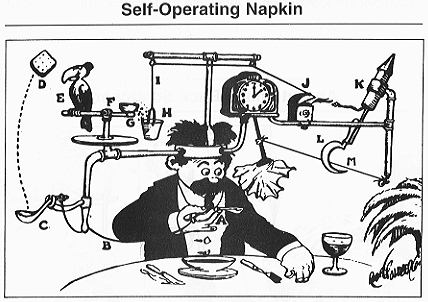
Better known is this film's main writer, Rube Goldberg. This famous cartoonist is best known for his cartoons featuring elaborate inventions that are created to accomplish simple tasks. At the time of this movie, his cartoon strips were appearing in Collier's Weekly. His famous elaborate inventions (known as Rube Goldberg machines) appear regularly throughout this movie as the inventions that the character of Otto Schimdt creates. Rube even has a brief cameo in this film.
A 1931 Rube Goldberg cartoon
Goldberg's co-writer was Lou Breslow. Fans of classic comedy might be familiar with him. He was a writer on the Laurel and Hardy movies, Great Guns (1941) and A Haunting We Will Go (1942), the Bob Hope film, My Favorite Spy (1951), Bud Abbott and Lou Costello in Hollywood (1945), The Ritz Brothers movie, Pack Up Your Troubles (1939), the Red Skelton picture, Merton of the Movies (1947) and an entry in the Blondie B-movie series (one of my favorite B-movie series), Blondie Goes to College (1942). He was also a writer on the Babe Ruth shorts that Benjamin Stoloff directed. Breslow would later direct the Stooge short film, Punch Drunks (1934).
Charles Winninger (who played Otto Schimdt) was a very accomplished character actor, who often appeared in films as a kindly old man (similar to his role here). His filmography includes such beloved movies as Three Smart Girls (1936), Nothing Sacred (1937), Babes in Arms (1939), Destry Rides Again (1939), Ziegfield Girl (1941), State Fair (1945) and Father Was a Bachelor (1950). He also appeared in the underrated Christmas movie, Beyond Tomorrow (1940). When making Soup to Nuts, he was just starting his movie career, though he had been performing in vaudeville since the age of eight. Born on May 26, 1884, he was a veteran entertainer by this time.
The leading lady here is Frances McCoy. McCoy did not appear in many films, though other than Soup to Nuts, she also appeared in a few musical shorts. Little biographical information is available about her. Even information about her birthdate and place differs depending on which source you look at. The Los Angeles Times on October 27, 1930, mentioned her having a nervous breakdown and returning home to New York. The address she would return to is 2390 Davidson Avenue, an address also given to her in the 1933 City Directory. This nervous breakdown seems a likely reason why her movie career was cut so short.
Fred Sanborn's role in this film is almost as a fourth stooge. He is a very wacky character and shares most of his screentime with Moe, Larry and Shemp. Though this is the only film in which he worked with the Stooges, it was not the only time he filled this role as a fourth Stooge. He appeared with them in A Night in Venice as well as some of their other early-stage appearances. In 1930 (the year this film was released), Sanborn performed as part of Ted Healy's act (along with Moe, Larry and Shemp) on January 1-4 at the Majestic Theatre in Chicago, Illinois, January 5-11 at the Subert Detroit Theatre in Detroit, Michigan, January 12-18 at the Shubert Theatre in Cincinnati, Ohio, February 1-7 at the Palace Theatre in Cleveland, Ohio, February 8-14 at the Palace Theatre in Chicago, Illinois, February 22 - March 7 at the Palace Theatre in New York City, March 22-28 at Loews State Theatre in New York City, March 29- April 4 at the Metropolitan Theatre in Brooklyn, New York, May 23-25 at the Shrine Auditorium in Los Angles, California, May 29- June 4 at Loew's State Theatre in Los Angles, California, June 5-11 at the Egyptian Theatre in Hollywood, California. After his time with Ted Healy, Sanborn would become a solo artist on stage. Sanborn would spend most of his career on stage and appear in very few movies. One of the very few movies he appeared in though were the Olson and Johnson film, Crazy House (1943), which also features Shemp in its cast.
1929 Night in Venice Postcard featuring Ted Healy, the Stooges and Fred Sanborn
The cinematographer for this movie was Joseph Valentine, who would have a very accomplished career. His filmography includes such films as 7th Heaven (1927), Three Smart Girls (1936), the W.C. Feilds and Mae West picture My Little Chickadee (1940), Abbott and Costello's One Night in the Tropics (1940) and Keep 'Em Flying (1941), The Wolf Man (1941), Tomorrow Is Forever (1946) and Possessed (1947). He would also be the cinematographer on three Alfred Hitchcock movies, Saboteur (1942), Shadow of a Doubt (1943) and Rope (1948). He would win an Academy Award for his cinematography in Joan of Arc (1948). He would work on one more film with the Stooges, Myrt and Marge (1933).
The Film Daily, 1930
Ted Healy gets a song number in this film. The song is called You Can Only Wear One Pair of Pants at a Time. The music for this song was written by James V. Monaco, who wrote the song You Made Me Love You (I Didn’t Want to Do It), originally a hit for Al Jolson in 1913, this song would later be sung by Judy Garland (with new lyrics by Roger Edens) in the movie, Broadway Melody of 1938 (1938). Judy would later perform the song in concert and on her TV show. Country singer Patsy Cline would also have a hit off of You Made Me Love You (I Didn’t Want to Do It). The lyricist was Cliff Friend, who co-wrote (with Dave Franklin) the song The Merry Go Round Broke Down (later the theme music for Looney Tunes). He also co-wrote (with Irving Mills) the song Lovesick Blues, which would later become the signature song for country music legend Hank Williams. The Varsity Eight made a recording of You Can Only Wear One Pair of Pants at a Time on November 3, 1930 (not long after the movie's release). The record advertised this song as being "From 'Soup to Nuts.'"
Exhibitors Daily Review and Motion Pictures Today, 1930
When he is asked how much gas is left in the firetruck, Shemp responds, "The needle is pointing halfway. I don't know if it's half-empty or half-full". This same gag would reappear in later Stooge films including, False Alarms (1936), Dizzy Pilots (1943) and The Three Stooges in Orbit (1962). The coin toss gag here was later reused in the Stooges short, Restless Knights (1936). At one part in this film, the Stooges sing, "You'll never know, just what tears are..." They would sing the same song in Beer in Pretzels (1933), Dancing Lady (1933), Fugitive Lovers (1934), Horses Collars (1935), Hald Shot Shooters (1936) and A Ducking They Did Go (1939). The Stooges repeated the sandbag gag was repeated on a 1950 episode of Ed Wynn's TV show with Wynn taking the place of Healy. The Stooges are Firefighters in this movie, they would later play firemen again in False Alarms and It's a Mad, Mad, Mad, Mad World (1963).
It's a Mad, Mad, Mad, Mad World (1963)
The money Ted Healy received from making this film amounted to $1250 a week. While a third less than his vaudeville salary, it was still a good amount of money for the time. Out of this money Ted paid each of his Stooges $150 a week.
Fox was less than impressed with the movie itself but were very impressed with the talents of Moe, Larry and Shemp. The executives offered the Stooges a seven-year contract to star in a series of feature length comedies. When Healy found out about this, he was furious. He stormed into the office of Winnie Sheehan, Fox's studio head, told him the contract was not valid without his approval and proceeded to physically tear up the contract. The Stooges found out about this and briefly left their old boss. They formed an act called Howard, Fine and Howard and would sometimes bill themselves as "Three Lost Souls." The comics performed at first on the west coast. Their first performance as a trio was at the Paramount Theatre in Los Angeles, California on August 28, 1930. In 1931, the trio teamed with performer Jack Walsh as a straight man that was very much a stand in for Ted Healy. The first performed with Walsh at the RKO Boston Theatre in Boston, Massachusetts on July 11, 1931. They would reunite with Healy in 1932. Their first performance back with Healy would be at the Memorial, Theatre in Boston, Massachusetts on August 7, 1932. It wouldn't be long until Shemp would leave the act and be replaced by his younger brother Curly (Jermone) Howard. Their first performance with Curly would at the Palace Theatre in Cleveland, Ohio on August 27, 1932. This all happened before the Stooges made another film.
Note: This post originally appeared on my Movies With Michael blog. Because Joe Besser voiced Babu the genie, I am posting it here as well.
More cartoon fun.
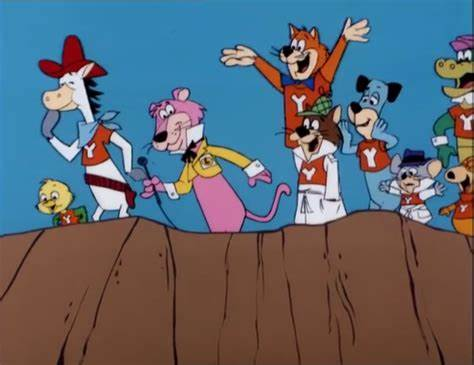
As a Hanna-Barbera fan, I admit that there is always something warm and cozy about seeing Hanna-Barbera characters from different series appearing together. Because of this Laff-A-Lympics holds a special place in my heart. This series featured three teams of Hanna-Barbera characters competing against each other in Olympic type events. These three teams were the Yogi Yahooeys, the Scooby Doobies and the Really Rottens. The Yogi Yahooeys consisted of many of the studio's earlier funny talking animal characters. The Scooby Doobies consisted of characters from the studio's mystery solving and crime fighting cartoons. The Really Rottens were the villains of the show and the only team where many of the members were created for this show. Snagglepuss and Mildew Wolf served as our hosts and the judges.
In Athens the teams compete in a pole-vaulting contest and a discus throw. In the Ozarks they compete in a rail cart race and a keel-boat race.
This is simply a lot of cartoon fun. The slapstick throughout here is delightful. The great slapstick humor begins with the very first event. Yogi Bear's pole vault going out of control and the way Mumbly misses the bar are both hilarious. Another great gag in this episode comes before the slapstick even starts. Tiny little Yakky Doodle competing in the discus throw, when the discus is larger than him is funny in and of itself. The punchline itself is delightfully clever. This episode also is delightful because of great settings. Both the Ozarks and Athens prove to be prefect settings for Laff-A-Lympics events. They both have a good sense of atmosphere, and the background art is wonderful here. The background art is always a treat in Hanna-Barbera cartoons of this time but the artwork in the Ozarks scenes is especially lovely looking.
This is a wonderful bit of cartoon silliness that is a pure delight to watch.
Note: This post originally appeared on my Movies With Michael blog. Because Joe Besser voiced Babu the genie, I am posting it here as well.
A strong start to a fun series.
As a Hanna-Barbera fan, I admit that there is always something warm and cozy about seeing Hanna-Barbera characters from different series appearing together. Because of this Laff-A-Lympics holds a special place in my heart. This series featured three teams of Hanna-Barbera characters competing against each other in Olympic type events. These three teams were the Yogi Yahooeys, the Scooby Doobies and the Really Rottens. The Yogi Yahooeys consisted of many of the studio's earlier funny talking animal characters. The Scooby Doobies consisted of characters from the studio's mystery solving and crime fighting cartoons. The Really Rottens were the villains of the show and the only team where many of the members were created for this show. Snagglepuss and Mildew Wolf served as our hosts and the judges.
In this first episode, the team competes in the Swiss Alps in such events as Downhill Skiing Contest, Free Style Figure Ice Skating, and 4-man Bobsleigh Race, as well as in Tokyo in Sumo Wrestling, Tennis and Baseball.
This is a truly delightful episode. Watching all these characters interact with each other is always a lot of fun. With this series' focus on cartoony slapstick, there are a lot of gags throughout and most of them are a lot of fun. The wrestling match with the giant Grape Ape playing for the Yogis is tons of fun. Captain Caveman and the Teen Angels' sled coming apart and Dynomutt's use of his robotic legs during a tennis match add to fun. I also love Fred Flintstone and Barney Rubble with their delightful cameo as they help coach Scooby-Dum in baseball. This episode is also full of delightfully corny puns. While I wouldn't say these puns made me laugh out loud, they made me smile because of how they embraced the corniness. Yet my favorite comedic moment comes from the appearance of Mumbley's mom.
Note: This post originally appeared on my Movies With Michael blog. Because Joe Besser voiced Babu the genie, I am posting it here as well.
A pure delight for Hanna-Barbera fans
As a Hanna-Barbera fan, I admit that there is always something warm and cozy about seeing Hanna-Barbera characters from different series appearing together. Because of this Laff-A-Lympics holds a special place in my heart. This series featured three teams of Hanna-Barbera characters competing against each other in Olympic type events. These three teams were the Yogi Yahooeys, the Scooby Doobies and the Really Rottens. The Yogi Yahooeys consisted of many of the studio's earlier funny talking animal characters. The Scooby Doobies consisted of characters from the studio's mystery solving and crime fighting cartoons. The Really Rottens were the villains of the show and the only team where many of the members were created for this show. Snagglepuss and Mildew Wolf served as our hosts and the judges.
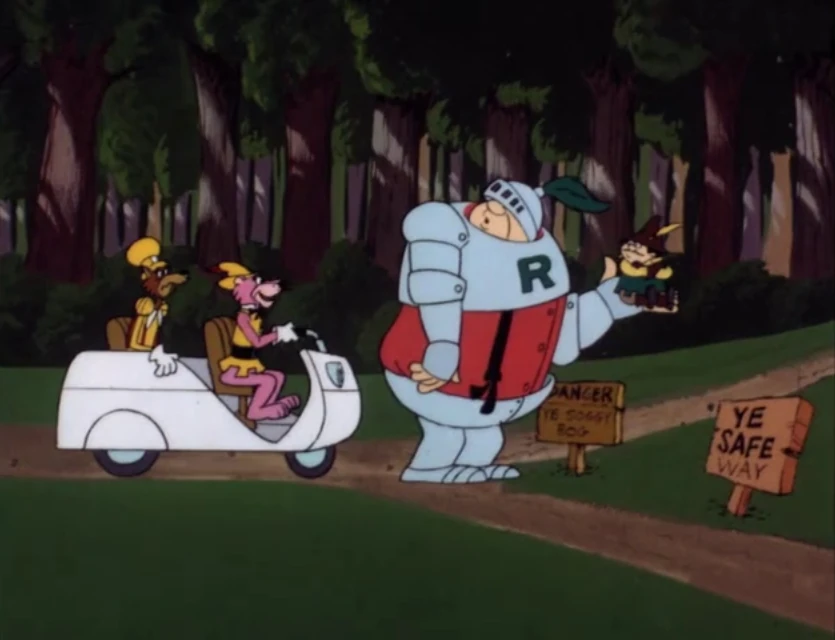
In this episode the teams compete in a "touch the tip of the pyramid" race and a camel race in Egypt as well as an armored foot race and a race to save the princess.
There is a lot to enjoy about this episode. The highlight is the two events in the Sherwood Forest. The Really Rottens having to be courteous and gentlemanly (both of which are taken into account for the events) is a wonderfully clever idea. Not only this but good use is made out of it. The contest to rescue the princess includes some of the greatest slapstick of the episode. Doggy Daddy's plan to reach the princess is downright hilarious. Having Daisy Mayhem be the fair delicate princess is a great gag in and of itself. Both of the environments that the teams compete in allow for some especially wonderful background art.
Note: This post originally appeared on my Movies With Michael blog. Because Joe Besser voiced Babu the genie, I am posting it here as well.
Another very fun episode.
As a Hanna-Barbera fan, I admit that there is always something warm and cozy about seeing Hanna-Barbera characters from different series appearing together. Because of this Laff-A-Lympics holds a special place in my heart. This series featured three teams of Hanna-Barbera characters competing against each other in Olympic type events. These three teams were the Yogi Yahooeys, the Scooby Doobies and the Really Rottens. The Yogi Yahooeys consisted of many of the studio's earlier funny talking animal characters. The Scooby Doobies consisted of characters from the studio's mystery solving and crime fighting cartoons. The Really Rottens were the villains of the show and the only team where many of the members were created for this show. Snagglepuss and Mildew Wolf served as our hosts and the judges.
In Acapulco, the teams compete in a diving contest, an underwater relay race and a speedboat race. In England the teams climb Big Ben, hunt a fox and have a polo contest.
Again this episode is full of the silly corny fun that I love about these 70's Hanna-Barbera cartoons. There are delightfully silly slapstick gags. This is especially true in the fix hunt scene which is a classic cartoon chase at its best. The speedboat race also has some great slapstick with Pixie, Dixie and Mr. Jinx as well as in the Big Ben scene with Shaggy using the anchor to reach the top and finding himself sein a Harold Lloyd type of situation. The episode is also full of delightfully corny puns. These puns might not be laugh out loud funny, but their sheer corniness makes me smile. Also delightful is Jabberjaw's cameo. I also really like that the scores between the three teams stay pretty close to each other making the games more exciting. This episode also benefits from some great background art during the Acapulco scenes.